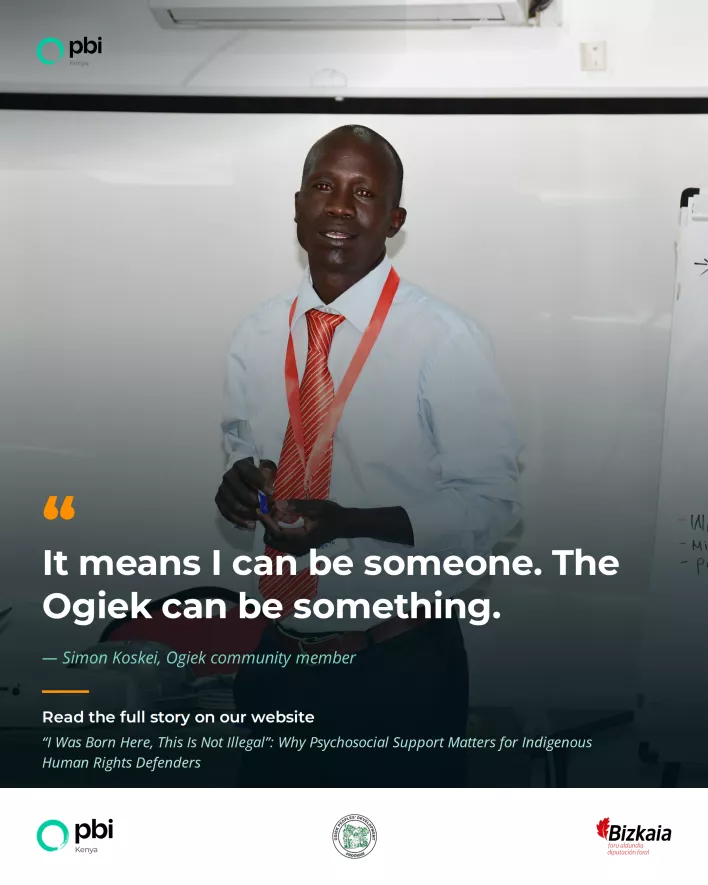
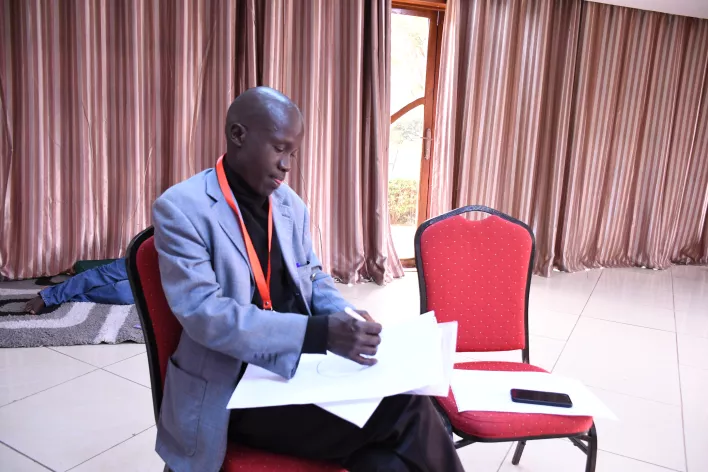
In May 2026, PBI Kenya facilitated a psychosocial support training bringing together indigenous community members from the Rift Valley, land and environmental defenders from CJEA, and women human rights defenders from Kilifi and Nairobi. The training was designed to equip participants with practical skills in trauma awareness, stress management, psychosocial first aid, and boundary-setting, tools relevant both to their personal wellbeing and to their work supporting fellow defenders and community members. It was during this training that we met Simon Koskei, a human rights defender from Kericho County, Londiani, Tendeno Forest.
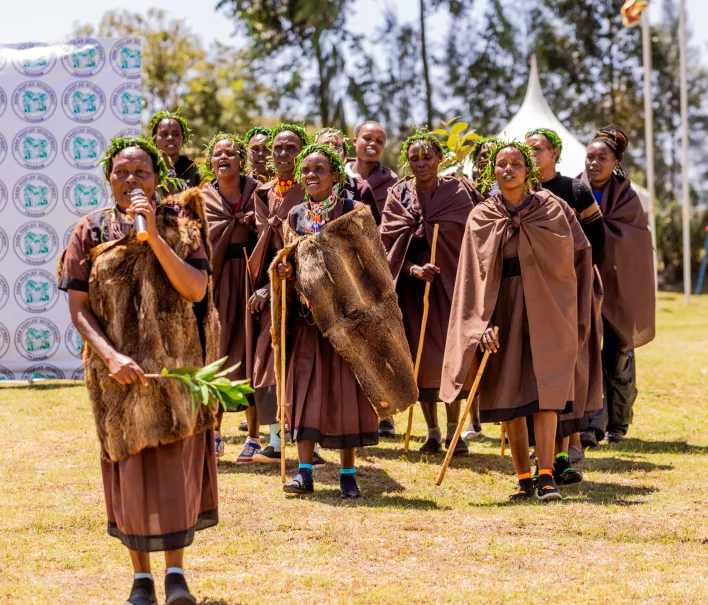
When asked to introduce himself, Simon starts not with his name but with his identity. “I am Ogiek,” he says. “A minority tribe in Kenya that has been forgotten by the government and the people.” Simon was born in Tendeno Forest. So were his parents. The Ogiek have lived in and around the forest for generations. It is their ancestral land, central to their identity and their survival. That connection has been repeatedly tested. The 1985 evictions displaced many families from the area. Some never returned. Simon’s family stayed, in part because his parents were employed by Kenya Forest Services, formerly the Forest Department, an arrangement that gave them a degree of security that most of their community did not have. But it was always conditional.
“Our settlement is never safe or guaranteed,” Simon says.
In recent years, conditions have tightened further. About three years ago, the community lost the freedom to plant maize on their land. Subsequent regulations further restricted the size and location of their farming areas. For a community with limited access to formal employment or markets, farming, particularly maize which is low-cost and reliable, is a primary source of food. “No maize means no food,” Simon says plainly.
The effects have been significant. Without stable food sources or income, families have struggled. School dropout rates have risen. Early marriages have increased among young girls, driven less by tradition than by economic pressure. Drug use has grown among older adolescents. Petty theft has become more common in the community, linked directly to food insecurity.
Access to basic services remains limited. There is no electricity in the forest. Infrastructure is poor. The community has no formal political representation, which creates a compounding problem. Without representation, accessing grants or government support programmes becomes extremely difficult. Despite being one of Kenya’s oldest indigenous communities, the Ogiek do not appear on the government’s official registry of ethnic groups, effectively excluding them from formal state structures. “We have no representation,” Simon says. “No politician is going to come to the forest to have a conversation with us.”
The community also contends with a persistent narrative that the Ogiek are environmental destroyers rather than the forest guardians they have historically been. Simon encounters this framing regularly, including from people in positions of authority.
“They’ll say, ‘What are you people doing in the forest,’ or ‘You people are destroying the forest,’” he says. “It’s tiring.”
Simon works as a human rights defender, collaborating with the Ogiek People’s Development Programme to serve as a link between his community and OPDP’s national advocacy work. His focus is resettlement, land rights, and formal recognition for the Ogiek within Kenya’s legal and political structures.
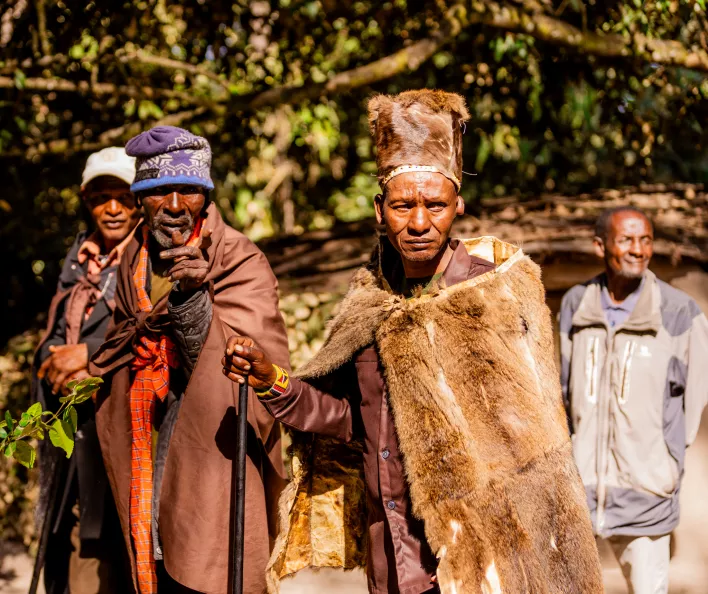
Last year, he received a personal eviction notice giving him 14 days to vacate. He contested it and remained. He believes the notice was connected to his visibility as a community advocate, and that removing him would make it easier to evict others.
“It’s hard to fight for people’s rights if you are not with them,” he says.
He describes his decision to do this work as rooted in his upbringing. His family has a history of community leadership, and he holds a broader commitment to human rights that extends beyond his own community.
“It’s not just about people in my community. It is ingrained in me to defend anyone’s rights, whether they are Ogiek or not.”
For Simon, attending the PBI Kenya psychosocial training carried particular significance. As a minority community member navigating high-stress advocacy work with limited institutional support, access to structured psychosocial tools is not something he has had before.
He describes the training as practical and immediately applicable. The skills around trauma awareness, stress management, and psychosocial first aid are things he plans to bring directly back to his community, to use in his own work and to share with community members who are carrying considerable psychological weight alongside their material hardships.
“The knowledge and skills I have acquired are things I can apply and take back to the community,” he says. “I’ve also learned how to approach things in a better manner, to be more solution-oriented, and sensitive to the cultural dynamics within the community.”
His goals remain clear. Recognition. Resettlement. Equal access to education, employment, and political representation. “We don’t need to be better than any other community,” he says. “We just want to be at the same level.”
Simon Koskei is one of many defenders working with limited resources and recognition to ensure that the Ogiek are not overlooked. The psychosocial training offered him practical tools, and with them, a renewed sense of purpose.
“It means I can be someone,” he says. “The Ogiek can be something.”
The implementation of this particular psychosocial training was made possible by Bizkaia.